Sunny Slope Orchard

Sunny Slope Orchard
In the coast range foothills overlooking the Sacramento Valley

Tuesday, August 7, 2012

Summertime, and the livin' is hot


Here in early August we're moving more slowly. Done with the frantic June/July harvest, we can now afford a more relaxed pace better suited to the summer heat. Not that there isn't plenty to do, but we are free from the unrelenting flood of ripening fruit during peak season.

Figs in the solar dryer
Our only commercial crop right now is second-crop figs; there are only two trees which we can easily manage. We are drying most now but starting next week will begin restaurant deliveries.

We seldom have extras for sale to the public, but this wonderful fruit can be found growing wild along many local roadsides. For recipe ideas check our previous posts here and here.


Drip irrigation in the orchard
With the apricot, peach and plum crop done for the year the trees are storing food in their roots and developing buds for next season's fruit. This period between harvest and winter dormancy is an important time in the cycle and despite our very dry summer soil the trees manage well. Their leaves will flag in the heat of the afternoons (as do we!), hanging limp and closing off their stomata to conserve moisture. But they perk right up overnight and put on vigorous growth year after year despite getting only a tiny fraction of the water lavished upon conventionally irrigated orchards. Our water supply is very limited so I use small emmiters dripping through mounds of compost to serve as watering/feeding stations that apply about 20 gallons of water per tree per week along with nutrients leached from the compost.


Juliet tomatoes
As the trees store up food for next winter we are busy doing the same. We've canned, dried and frozen loads of fruit and now are hoarding garden crops. As usual our favorite tomato variety, Juliet, is producing like crazy and Fern is filling the pantry with canned tomatoes, soup and salsa.  Green bean vines are growing inches a day and okra is producing heavily.

Okra blossom


A rattlesnake waits for a passing rodent


Of course everyone has to eat and rattlesnakes are no exception so this time of year we have to be careful where we step or reach. We recently were treated to the sight of two big gopher snakes mating. They seemed quite enthusiastic and not at all self conscious, writhing and twisting for several minutes as we stood there watching!
Gopher snakes making whoopee
Our resident hummingbirds are entertaining us with their feeding frenzies, emptying two large feeders daily. While too numerous to count we estimate that hundreds must live in the area.


So mid-summer offers much to do but also lots to see and enjoy. Life is good and we experience each sunset with appreciation for the day's gifts.


Friday, June 29, 2012

Plum Crazy


Santa Rosa Plums are a complex fruit. When fully ripe, their skin is dark purple, almost black, while the flesh is reddish-pink underneath, turning golden yellow closer to the pit. The fragrance is heady with hints of wine and spicy freshness. Our Sunny Slope Santa Rosas are exceptionally juicy this year. Put all this together and you have a knock-out plum that combines tart with sweet and subtle with bold.

a plum & fig galette
Right now we have the last of our 2012 crop available for sale.  We recommend them for baking into tarts or galettes, topped with ice cream for your Fourth of July celebration. They make an amazing plum sauce, which is delicious on pancakes or yogurt and is terrific for home canning.  Of course, you will enjoy eating these plums fresh, out of hand or in your fruit salads. And did we mention plum sorbet?

Our past blog posts have links to all of these favorite recipes….
For plum sorbet recipe: http://sunnyslopeorchard.blogspot.com/2010/07/after-june-harvest-frenzy.html

For links to plum galette and plum compote recipes: http://sunnyslopeorchard.blogspot.com/2011/07/santa-rosa-plums.html
Plums in the cooler
All our trees have been harvested as of today and we have a limited supply of our #2 grade plums in our cooler. These are fruits that are smaller or have minor skin blemishes. Flavor is still first-rate since all our fruit is truly tree-ripened.

You may buy a large box of Santa Rosas for $45; each box contains 18 pounds of fruit at $2.50 per pound. For smaller quantities, weighed out by the pound, the cost is $3.00 per pound. If you are coming from a distance or want us to reserve fruit for you, please call or email us ahead of time to be sure we have the amount you want.

Have a happy Independence Day!

Monday, June 11, 2012

Harvest update - Last chance for peaches!


We are having the shortest peach season ever. Sudden hot weather has them all ripening with our last pick likely to be Wednesday June 13th. It has been a heavy crop so we have plenty for making that Father's Day peach pie, but cannot promise we will have any past mid-week.

We are picking apricots every day and filling orders on a first come, first served basis. We are hoping this week's forecasted high heat will not damage those still on the trees.

Saturday, June 2, 2012

The 2012 harvest has begun


This morning, June 2nd, I picked the first of our Royal Blenheim apricots and Springcrest peaches. Up on a ladder, watching a Red Tail hawk circle and hearing a Pileated woodpecker call in the distance, eating any fruit that was too tempting to put in the bucket, I almost didn't mind the blazing sun.

So far the flavor of both cots and peaches is exceptional. We had enough winter rainfall and now enough heat for proper fruit development, but have been spared extreme conditions that can stress the trees and lessen flavor. For an added boost I did several foliar feeding sprays on the peaches and plums during the critical bloom through fruit development stage, applying liquid fish and kelp extracts as well as trace minerals. This appears to have given the trees everything they needed during this stage of intensive growth of leaves and fruit. Leaf and fruit color, fruit size and flavor, and overall vigor have never been better.

Apricots
We expect cots to start coming on heavy around June 10th or so. How long they last depends heavily upon the weather as too much high heat can ruin the last of the fruit.
Peach trees are showing a strong response to foliar feeding
with deep green leaf color, dense growth and high fruit flavor


Peaches should be available starting June 7-10 and lasting about 2 weeks.


A Santa Rosa plum tree exploding in lush growth

Our all out assault on the leaf curl plum aphid this year has been a real success. The trees are now completely free of the pest that in the last few years has sapped their strength and reduced fruit quality. Tree vigor and fruit size are outstanding once again. We expect plums to ripen starting in late June.

Fruit Sales: To check on fruit availability just give us a call at 707-448-4792. Also check out "What is Ripe Now" link on this blog.

Wednesday, May 16, 2012

Good bugs, bad bugs


A lady bug feasting on green aphids

When the subject of organic agriculture comes up people often ask, "But what do you do about bugs?" My answer starts with, "well, there are good bugs and there are bad bugs. We do everything we can to encourage the good bugs so they will help us to control the bad ones."


It’s a basic fact of nature that all life is interdependent and is generally in balance until we humans come along and upset things. Where there is a crop damaging pest there is usually a predator present that feeds on that pest. The photos above and below are examples.

Eggs from the green lacewing (on stalks), a
major predator of aphids, laid among the aphids
So the conventional approach of indiscriminately using broad spectrum pesticides kills not only the pests but the predators that help to keep pest numbers from exploding. That often causes a more serious problem by upsetting nature’s equilibrium. In the worst case this can lead to worsening pest outbreaks requiring ever more powerful pesticide applications, leading to a host of problems from toxic residues on the crop to environmental pollution to pests developing immunity.

 
A more natural approach of working with, rather than against, nature can yield the best results. This means identifying the pest, learning its life cycle and natural enemies, and then creating conditions that make life difficult for the pest and favorable for the beneficial insects that prey upon the pests. Most importantly this means accepting a certain amount of pest damage, since without pests there would be no reason for their predators to stick around and help to control them.
 
A case study
Tools of the trade, a microscope and loupe for
identifying the pest curling these plum leaves
So how does one go about this type of natural pest control? Here is one example. One of the most common springtime pests are aphids, and over the past couple of years we have had a serious outbreak of the Leaf Curl Plum Aphid on our Santa Rosa plum trees. Last year the infestation reached the point of weakening the trees and reducing fruit size and quality, so this year we launched a "shock and awe" campaign, deploying every available strategy against this pest.

First, following the admonition to "know your enemy," I researched its life cycle and consulted with the county ag commissioner, a supplier of beneficial insects, and UC Davis resources. Eliminating ants is essential to controlling aphids since they "farm" aphids just as humans farm cows, so when ants are present any aphid control effort will have limited success. We had carpenter ants in the plum trees, so step one was to set out ant bait stations to gradually kill the colonies but also to band the trees with sticky Tanglefoot as a barrier to crawling insects.

This particular aphid lays eggs near plum tree buds in the Fall, so step two was to apply two dormant season sprays of an organic mineral oil to smother the over-wintering aphid eggs.

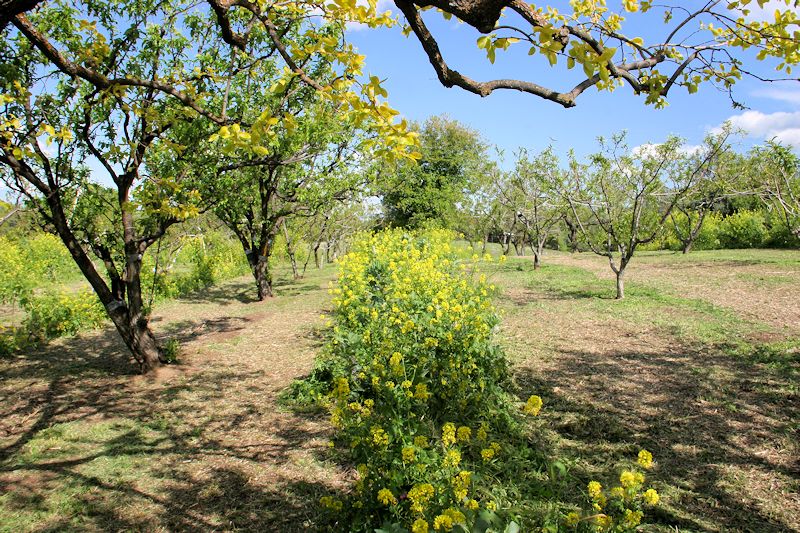
Strips of legume and mustard cover crop left
unmowed as habitat for beneficial insects
The aphids begin to hatch around bloom time, so step three was to maximize predators that feed on aphids. We always grow a winter cover crop that attracts and nurtures lady bugs, lacewings and other beneficials. It needs to be mowed down in the Spring to conserve soil moisture, but I leave unmowed strips as beneficial insect habitat as long as possible. But this year I went a step further by doing three releases of lacewings and a predator midge (a tiny fly with a voracious appetite for this particular aphid), purchased from an insectary as eggs.
Pheromone lures hung in plum trees
to attract beneficial insects

Step four was to hang pheromone lures in the trees that attract beneficial insects, as well as cards painted with beneficial insect food - a mixture of soy flour, nutritional yeast, and calf milk replacer - to keep the beneficials as healthy as possible. In addition I have found a pheromone attractant to draw the aphids to a sticky card trap.

Even with all these efforts we have had some spot outbreaks, but they are very minor compared to past years. I am currently employing a final step of clipping off the worst aphid infested shoots, dousing them in a bucket of soapy water and discarding in the trash. And here I need to grit my teeth and remember the principle of nature’s balance: there have to be some pests present in order to keep the pest’s predators around. So when I reach to clip off an aphid infested shoot and see lady bugs or lacewings present, I am reminded that in this instance "zero tolerance" is not the best approach. My hope is that the benefits of all these efforts will compound in future years, as the life cycle of the pest is disrupted and the beneficials gain the upper hand.

Toads live under cover during the day,
come out and eat slugs at night
Once you start thinking in terms of maintaining nature's balance, many pest control strategies become obvious. Those spiders that build webs in your potted plants? They are ferocious hunters of many plant damaging insects so it is best to leave their webs alone. That toad hanging out under your garden stepping stone? He comes out at night to eat slugs and snails, so it's helpful to install more toad housing in the yard. And that pest control guy that comes and sprays all around the house? He's ensuring job security for himself by killing pest and predator alike, making it easier for the pests to rebound.

Some information and products for natural pest control can be found here:
  • Your county Ag Commissioner’s office can help identify plant pests and diseases and suggest remedies
  • UC Davis has excellent online pest & disease information at http://www.ipm.ucdavis.edu/
  • Cornell University has a great guide to biological controls at http://www.biocontrol.entomology.cornell.edu
  • There are a number of online suppliers of natural pest control products, here are two:
http://www.rinconvitova.com
http://www.arbico-organics.com
Sunday, March 18, 2012

Orchard Acvtivities Winter to Spring


This winter was the wet season that wasn't. The Fall rains we count on to get the cover crop growing were few and too far between. But by moving drip lines around several times a day for weeks, the peas, bell beans, vetch and mustard mix actually put on some respectable growth. Despite our very limited well water the place has looked like an oasis of green since November compared to the surrounding hills.

A couple of teaser storms in January raised our hopes, but as the trees awakened from dormancy in early February there was no rainfall in sight. So I mowed down most of the cover crop to stop it from consuming soil moisture, and began doling out meager amounts of water again, this time to benefit the trees.

Little apricots
We were rewarded with a very heavy bloom and the promise of a heavy fruit set. And so far things look good, with most trees bristling with little apricots, peaches and plums.

So now we continue into Spring with our usual conflict of interest: we want lots of rainfall to help the trees through the coming dry summer and to recharge our aquifer, but apricots, especially, are really prone to fungal diseases in wet weather so a dry spring makes for clean fruit. With some luck we will receive the right balance of help and harm from mother nature.


In other news: Composting
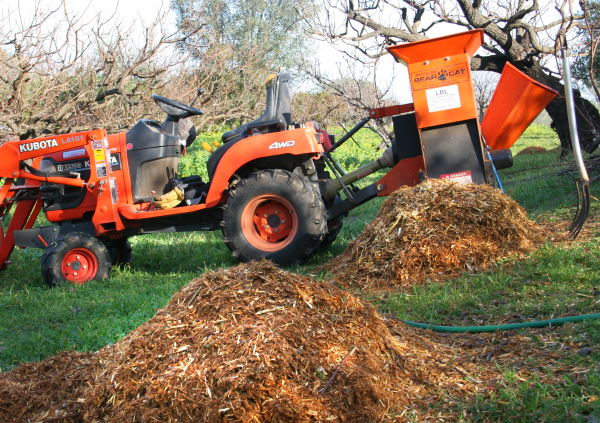
Following pruning, one of winter's chores is chipping up all the orchard brush and making compost. Like everyone else I used to burn orchard prunings every spring. But after awakening to the huge value of compost as a soil additive, I can't stand to see this resource go to waste. One only has to walk into an undisturbed forest, scrape away the top two inches of rotting leaves and bark, scoop up a handful of soil and take a sniff to understand where soil nutrients come from. It will smell moist, earthy, sweet and fragrant, teeming with fungus and microbes cycling nutrients back into the soil. In contrast, grab a handful of dirt from a finely cultivated agricultural field and you get finely powdered minerals smelling of dust. One is soil, the other is just dirt. One feeds the plants, the other just keeps the plants from tipping over in the wind. Organic matter is the difference. So any crop waste we can return to the soil is a net gain in fertility.

Composting is a process of maximizing the nutrient value of organic matter while destroying weed seeds and pathogens with heat. This requires the right proportions of moisture, carbon, and nitrogen for biological life to digest the raw ingredients and turn them into plant-available nutrients. To the chipped prunings I add horse manure from a neighbor's ranch and enough moisture to dampen. When the recipe is right the microbial activity heats the pile up and breakdown happens quickly.

Healthy decomposition needs to be aerobic, so to keep things cooking well I assemble the pile with perforated drain pipes inside to keep oxygen available. For the first 20 days or so I turn the pile every few days with the tractor to ensure all materials are evenly digested. After a few weeks the pile cools off and earthworms, molds, and other critters continue digesting the raw materials into fertilizer. It then goes back into the orchard and ultimately into new growth of trees and fruit.

Tuesday, January 24, 2012

Mid-Winter Rain Celebration

We are in a cheerful mood after a generous storm last weekend dropped nearly six inches of rain on our orchard and garden. The effects of this water were immediately obvious: green moss magically appeared on rocks, the cover crop perked up, and the soil feels soft underfoot like a carpet.

To celebrate, we reached into the pantry for a jar of the pears that we canned last summer and proceeded to make Pear Gingerbread, one of our favorite winter desserts. Perhaps you will be tempted to try it in your kitchen too.

This recipe is adapted from Joy of Cooking; the original source recipe is on page 681 in our edition of this classic cookbook.  
Pear Gingerbread
Preheat oven to 350 degrees. Grease a 9 x 12” baking pan with butter. Take a quart jar of pears and drain off all the liquid, reserving it for use later. Place the pear halves, cut side down, in the greased pan.
Melt 1/2 cup butter in a heavy pan and let cool. In a large bowl, combine ½ cup sugar and 1 egg with the melted butter and beat well.
In a medium bowl, sift (or whisk) together 2 ½ cups flour, 1 ½ tsp. baking soda, 1 tsp. each ginger and cinnamon, and ½ tsp. salt. Note: the original recipe calls for all-purpose flour, but we usually use whole wheat flour for at least ½ of the total amount of flour.

Heat one cup of the reserved liquid from the jar of pears until quite hot but not boiling. In a medium bowl or a very large capacity measuring cup, combine ½ cup honey, ½ cup molasses, the 1 cup of hot liquid, and 1 Tbsp. orange zest.
Add the flour mixture and the liquid ingredients alternately into the butter mixture, stirring until blended. Pour the batter over the pears in the pan to cover them completely, being careful not to let the pears slide around. Bake about 1 hour, then serve warm or cold. A topping of Santa Rosa plum compote goes well. And of course a generous blob of whipped cream doesn't hurt either!


Work on the farm continues year-round, but the pace definitely is more relaxed in the winter. The trees are all pruned now, looking tidy with well-spaced branches reaching upwards, waiting for the longer warmer days of Spring. With pantry shelves and freezers full of good food, we look around us and feel quite content and peaceful.
But, wait! It looks as if the apricot buds are starting to swell again….

Apricot fruit spurs, buds swelling