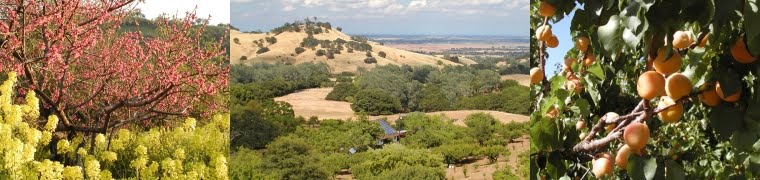
Sunny Slope Orchard

Sunny Slope Orchard
In the coast range foothills overlooking the Sacramento Valley

Wednesday, July 20, 2011

Our dry farmed/No-till soil management

Our last post began a discussion of how we manage soil moisture and fertility. To summarize, our orchard is mostly dependent upon winter rainfall rather than summer irrigation since water is very scarce in these hills. This area was historically "dry farmed." And according to the gospel of dry farming, that meant cultivating the soil as soon as it was dry enough to work in the spring. The object was to plow under all winter weeds so most of the winter/spring rainfall was preserved for the orchards instead of going into weed growth. To "seal in" the moisture, the ground was cultivated repeatedly as weeds re-emerged, leaving a fine "dust mulch." Unfortunately the result of bare, finely cultivated soil is erosion of top soil, death of soil building organisms, and continual loss of fertility.

So our challenge with dry farming is how to save the maximum rainfall moisture for our main crop (orchard trees), while also preserving and improving soil fertility. Our solution has been to simply mimic nature's soil building process, with some enhancements. Some years back I began planting a cover crop in the fall, one that adds maximum organic matter and nutrients to the soil, rather than just letting native weeds grow. I also stopped tilling every spring, opting instead to just mow near the end of the rainy season. The result has been a real slowdown in erosion and a big increase in fertility, all with no apparent sacrifice in soil moisture.

Now instead of a finely powdered soil devoid of life, we have the rich porous soil pictured here, protected from sun and wind by cover crop residue, full of decaying roots that microbes turn into fertilizer, and permeated with earthworm holes that allow air and water to enter. Instead of winter rain runoff looking like chocolate milk, very little rain runs off since it is slowed by dense cover crop and easily soaks into the sponge-like soil. In short, our soil is now capturing and holding more moisture and building more fertility. Our annual soil test lab results show high to very high nutrient levels and steadily increasing organic matter content, all without any inputs other than compost and natural mineral amendments.

Because soil biological activity is nature's fertilizer factory and all soil life requires moisture, we use what meager well water we have to do some minimal drip irrigation through the dry summer season. Call it "dry farming plus." By putting a mound of compost under each drip irrigation emitter, we create small zones where earthworms and microbes flourish. These function as feeding stations for the trees, providing a small but steady supply of nutrients and trace minerals.

A mass of fine feeder roots forms under each mound, absorbing nutrients along with a bit of water. The amount of water is only a tiny fraction of what irrigated orchards get, but our big juicy fruit, deep green leaves, and rampant tree growth speak for themselves. Clearly the trees are getting plenty of what they need. Because they have never been irrigated, the root systems have grown deep to survive the dry summers. And while they will look a bit stressed during low rainfall years, the high soil nutrition gives them the strength to cope until the fall rains start again.

What really drives our passion for the orchard is fruit flavor. We are gratified to hear customers frequently comment, "that was the best I ever tasted," or "I haven't tasted fruit like that since I worked on my grandparents' farm." Producing such exceptional fruit with minimal water and without synthetic chemicals just feels right.

Wednesday, July 13, 2011

Our June/July harvest limps to an end

The last of our first-crop figs and Santa Rosa plums are picked, and we're ready to get on to other work. Harvesting is usually satisfying, seeing the literal fruits of our labors lined up handsomely in boxes. But this year was a challenge, with the late June rain causing heavy losses and defects due to splitting and mold. But one of the things we value most about rural living is a close connection to nature. And with that comes the frequent reminder that nature is in charge. So we are challenged to learn more about the interaction of weather and tree crops, to have realistic expectations, and to accept a bad year now and then. Not such a bad deal.

On the plus side, the long and wet rainy season is a big boost for our dry farmed trees, which depend upon rainfall moisture left in the soil to last them through the summer. Traditionally, "dry farming" means growing a crop with little or no irrigation beyond rainfall, then conserving that rain moisture by maintaining a finely-cultivated soil surface to act as a dirt mulch. The hills around us were always dry farmed since orchards were first planted in the mid-late 1800's, simply because water is very scarce here.

Unfortunately, the downside of thorough tillage is soil depletion. Bare, loose soil loses fertility through erosion by wind and runoff. Plus, plowing and turning the soil interfere with nature's topsoil building process. Soil is improved when the right plants cover its surface, protecting it from sun and wind; cover crops grow, die, decompose and cycle nutrients on to the next season's plantings.

For many years I followed the traditional dry-farming tilling methods because I was told that was necessary to maintain adequate soil moisture. And after all that's the way it had always been done in these dry hills. But several years ago I began to worry that I was losing too much fertility and decided to take a chance and stop tilling altogether. By going to a "no-till" system of growing a Winter cover crop, I now mow rather than till in the Spring, so the orchard floor is always covered with plant matter. Our best topsoil no longer migrates downhill with each pass of the disc or heavy rainstorm, and though the cover crop uses up some soil moisture, the improvement in soil quality and fertility more than make up the difference. More on this topic next time.

A refreshing summer salad


With hot weather finally here we think of flavorful salads. And with figs and grapefruit on hand we consulted our friend Google and came up with this recipe for Grapefruit & Fig salad

The juicy tart grapefruit pairs well with the sweet fig slices, and the mildly spicy dressing ties it all together. The recipe calls for mango juice, but we juiced the last of our apricots and used that. Pineapple would work well too. And a few nuts would be a fun addition, we're thinking toasted pecans. Enjoy.

Friday, July 8, 2011

Santa Rosa Plums

The good news/bad news saga continues now with the plum crop. We have been able to provide some tasty plums to our commercial clients in the Bay Area. But since the plum crop was light, just like the apricots, we didn't get the yield we normally expect. The rain also affected the earliest Santa Rosa plums, causing some of the cracking and spoilage that we had in the cots. As always, though, our Santa Rosas have great flavor. The tangy purple skin surrounds juicy flesh that tastes sweet, bold and complex.

That being said, there are a few culls available for canners and bakers to enjoy. Give us a call if you are interested in them.

Last year we recommended a Santa Rosa Plum Compote recipe that is found on the web at epicurious.com. Here it is again:
Santa Rosa Plum Compote

This year we tried a recipe for Santa Rosa Plum Galette from Mary Jo Thoresen, famous pastry chef at Chez Panisse. Her recipe and detailed instructions can be found online at this link:
http://www.jojorestaurant.com/news/chronicle6-2000.html


A slice of this dessert topped with the best vanilla ice cream you can find is an incredible combination of flavor and texture, combining tart and sweet to perfection.

We are all indebted to Luther Burbank for cultivating this superb plum. In California, Arbor Day is celebrated on March 7, the date on which he was born in 1849. Now is a good time to make a plum galette, freeze it unbaked, bag it in a plastic bag with all air removed and place it in your freezer. On March 7, 2012, pull it out and bake it.

In addition to the Santa Rosa culls, we have Texas Pink Grapefruit available and a small supply of first crop Black Mission figs. Our phone is 707-448-4792.

Thursday, June 30, 2011

A rain disaster

Well, the apricot crop that we have nurtured for so many months suffered a major blow on Tuesday June 28th in the form of 1.3" of rare June rainfall. The result is lots of splitting as the ripening fruit absorbed the water and swelled. And with fungus and mold problems already prevalent from our very wet spring, we expect to lose lots to rot. And what we do pick cannot be trusted to have much of a shelf life.


Splits in apricot skin allow mold and fungus
So now with half the crop still on the trees we're in salvage mode, trying to put some of the fruit to good use while disposing of moldy fruit before it spreads its evil spawn.

So canners and jammers, sharpen your paring knives as now is your chance to pick up some bargain fruit.

It's first come, first served, but hurry since the heat wave coming in the next few days will complete a one-two punch on this year's cot crop. And this, folks, is why so many apricot orchards have been torn out over the years.

Friday, June 24, 2011

Apricots are here, time to eat and make jam!

At last, the apricots are beginning to ripen. We have started picking and should have fruit for approximately two weeks. We have lots of orders for apricots and a smaller-than-usual crop, so do call ahead before driving up here to be sure we have what you want. Phone 707-448-4792.


We ran out of our 2010 apricot jam very early this winter. The recipe was new to us and was intriguing because it used both the apricot flesh and the kernel found inside the pit. The full recipe can be found in Chez Panisse Fruit by the incomparable Alice Waters on page 25. This recipe alone is worth the price of the book; but any fruit lover will find dozens of delicious ideas inside as you work your way alphabetically through the crops, one chapter at a time, from Apples to Strawberries. Buy this book!
Alice uses just four simple ingredients for her jam: apricots, sugar, a few apricot kernels (called noyaux) and lemon juice. We followed the recipe as written except that we reduced the amount of sugar to suit our taste. That yielded us a softer jam; it was more the texture of a thick sauce. We loved it on pancakes, toast, and ice cream. Four thumbs up, our highest praise!
Another version of apricot jam, using similar techniques but not calling for cot kernels, is available in Fanny at Chez Panisse: A Child’s Restaurant Adventures with 46 Recipes, written by Alice Waters, Bob Carrau and Patricia Curtan.
Not all fruit is born perfect; Mother Nature likes variety and is apparently bored by sameness. This spring's weather was unusually wet and the result is lots of scarred fruit. We sort our crops  into three categories. Our #1 grade is the most perfect, with the best size and appearance. The #2 grade has some skin blemishes and oddly-shaped fruits. The #3 grade are the culls; they include over-ripes, bird pecked and insect-damaged fruit. To be frugal and use the harvest to the fullest, we try to find good homes for all our fruit.
Here on the farm, we use a lot of culls for jam making, drying, freezing and baking. This year, for instance, most of our apricots have some shot hole fungus because of the late rains. The taste of the fruit is unaffected but the tongue feel of these “freckles” may not be suitable in all dishes. Over the years we have found it wise to have sharp knives in the kitchen and use them well. I love the fruit that is picked dead-ripe off the tree and am willing to cut my way through lots of culls to get those soft, succulent apricots for my jam.
One final story from a woman who lives in Italy and shops the farmers markets there: At Italian outdoor markets, a customer tells the seller how many fruits she wants and the farmer selects them. If she requests three fruits, she gets one perfect, one somewhat blemished, and one ugly. That way all produce is put to good use instead of ending up discarded. Seems an admirable custom given that in our country almost half our food is wasted.

Saturday, June 18, 2011

Harvest update June 18th

Peaches are going, going, almost gone. We've had the shortest peach season ever, and expect to do the seventh and last picking tomorrow, Sunday 6-19. Most #1 and #2 grade peaches are sold or spoken for, but for jam makers or bakers we will have cull peaches available until probably June 21st. These are undersized or damaged fruit best for processing uses where some sugar is added.

Cots are still mostly green(!) so it looks like picking won't begin until maybe June 24th or so. And due to extremely wet and cool weather this winter & spring, the crop is much lighter than in recent years and has a fair amount of fungus damage. So for our longtime customers we will do our best to get you some cots but unfortunately cannot make any promises at this point.

Saturday, June 11, 2011

Finally, signs of ripening!

It's been an unusual year so far, with almost continuous below normal temperatures. As a result some of the fruit is very late in ripening. Surprisingly, we were still using the wood stove just a week ago when most years we would be needing to cool the house starting in May. But at last we're seeing some progress.

Peaches are coloring up nicely and we are just doing the very first picking here on June 12th, not much later than usual. The first few to ripen are always "seconds", with split pits or other imperfections. But we expect to have good supplies of quality Springcrest peaches starting around June 15 - 18.


The apricots are another story though, still mostly green and hard. We don't expect to be picking many until around June 20th or later. Just a few are starting to get a tiny bit of orange color, about what you would find advertised at Safeway as "Ripe Summer Fruit!" But we insist on letting fruit ripen on the tree as far as possible, picking when it is just a couple of days from dead ripe. We lose some to wind, rot, and birds that way, but the taste difference is night and day compared to fruit picked too green.

Frequent spring rains keep fungus spores active, so this year we expect to lose more fruit to brown rot, a nasty fungus that can spread quickly over a fruit both before and after harvest. So the fruits' keeping quality will probably suffer a bit. This year the apricots also have much more "shothole fungus," those freckles visible in the picture above. This is mainly just a cosmetic problem though, and after all who among us is completely free from a few warts and moles?

Santa Rosa plums will be later than usual as well, probably starting around the end of June. Please bear in mind that these dates are just rough estimates; hot weather can and often does fool us. So check back here often during the season for updates and feel free to call with your specific needs. We won't be setting up the fruit stand outside the gate until we have cots in good supply, but are happy to take specific orders for fruit ahead of time for customer pickup. Call us at 707-448-4792, or email to fern@spurlocktools.com.

While we wait for the fruit to ripen we're busy setting up our famous bird scare machines, a variety of home built contraptions that limit bird damage and amuse passersby. This photo shows one device in action, with flying plastic bottles tethered to gyrating ropes. An electric motor drives the system and is controlled by an intermittent timer. Videos of the machines in action can be found here: http://billspurlock.myphotoalbum.com/view_album.php?set_albumName=album03
Follow the link and click on "slideshow." Don't laugh, they work!