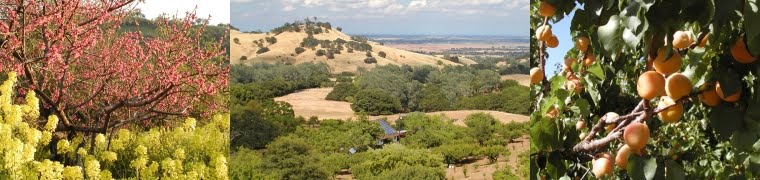
Sunny Slope Orchard

Sunny Slope Orchard
In the coast range foothills overlooking the Sacramento Valley

Saturday, March 12, 2011

A Successful Bloom!

We're now basking in the afterglow of a wonderful heavy orchard bloom, thankful that mother nature and our trees have come through once again - no devastating hail storms or severe freezes to ruin the blossoms, but cooperative weather that let the trees burst out in glorious bloom.

Apricots in full bloom
Peach trees at sunrise


The flower buds formed during last year's growth, then sat dormant overwinter waiting for the required 400 or so chilling hours (hours below 45 degrees) needed to make them viable. Once the required chilling hours have been met, the next hurdle is avoiding extreme cold during bud swell, bloom and beyond. So far so good.


Bristling with little pea sized fruits, the trees are now sprouting this year's leaves as they transform from winter's dormant skeletons into vibrant bushy fruit factories. Notice that the tiny apricots already show the beginnings of that beautiful red blush that makes them drop-dead beautiful when ripe.

For the next few weeks the main hazard for apricots are fungal diseases, a problem made worse by wet weather. We try to minimize this by spraying a copper compound several times during the dormant season.

What's that, how can you be organic if you spray? Well, the question is not whether you spray, but what you spray. Spraying is just a method of applying something to a plant. We use a sprayer to apply many things to the trees: fish emulsion and kelp for foliar feeding, bacillus thuringiencis (a naturally occurring bacterium) to kill leaf eating caterpillars, a light colored clay powder to reduce sunburn on walnuts, a natural soap solution to control aphids, and a copper product as a fungicide. The key is that any "input" to our farm must be labeled as approved by the Organic Materials Review Institute (OMRI). Generally that means only non-synthetic ingredients. Copper is a naturally occurring (and necessary) soil nutrient, not a synthetic chemical, and the particular product we use is OMRI approved. But first and foremost we try to promote a condition of balance in the orchard where diseases and pests are kept in check by natural enemies. More on this topic next time . . .

Sunday, February 27, 2011

Bloom Time

In a way, bloom time is a period of climax in the orchard, when the benefits of pruning, composting and cover cropping launch this years fruit crop. This regular routine of pruning and soil enrichment, together with kind weather, almost always delivers a heavy bloom in our trees. So this is always a season of optimistic anticipation of healthy blooms and a good fruit set.

So far this season has been good, nice and wet but yo-yoing from warm to cold and dry to wet, in all combinations. So we've had a start/stop in the bloom where some flower buds  opened and set fruit in our warm early February, but most stalled when the weather turned unusually cold

This photo shows buds in several stages on one stem: the red "popcorn" stage buds just ready to burst open, the white petaled fully open flower, and the lower bud after pollination and petal-drop, with a tiny apricot forming inside. Those are the ones we like to see.


Meanwhile the cover crop is maturing into a lush mini-forest of green matter. Right now the orchard floor is an absolute jungle of microbes, fungi, earthworms, insects, and birds. The bell beans, peas and vetch loosen the soil with deep roots, bring soil minerals to the surface, capture nitrogen from the air, attract beneficial insects and pollinators, prevent erosion, and hold rainfall on our slopes. Later it will be mowed, left to break down and feed the microbes that then feed the soil, which then feeds the trees.


Bell beans blooming
I'm convinced that one of the major benefits of a cover cropped, mowed-not-tilled orchard is the habitat it provides to beneficial insects. There will always be opportunistic bad bugs, but attracting a diverse insect population helps to keep things in balance. The bell beans in the cover are just popping out, and are alive with lady bugs, green lacewings, and bees, all doing their good deeds. Next the field peas will bloom and finally the vetch, providing an ongoing habitat for beneficials.


Mustard is another great part of the mix, with a great root system and a heavy load of pollen. Native bees, bumblebees, and honey bees all like to come.

So, for the next three weeks we're anxiously waiting to see how the fruit set turns out. We'll be hoping for mild dryer weather during peak blooms but also for more rainfall to store in the soil to get us through next summer. We're optimistic!

Wednesday, January 12, 2011

Pruning Season

This is pruning season in the orchard, the time of year when I give all the trees their annual haircut. Pruning accomplishes several things: removal of dead and weak growth, opening up space for ladder access and to allow sunlight and air circulation into the lower parts of the trees, and limiting the height and spread of the trees.

Without regular pruning most types of fruit trees lose vigor and become too tall and cluttered. Stone fruits especially require heavy annual pruning. The fruit bearing shoots only live for 2-3 years, so pruning stimulates constant growth of new fruiting wood. And left unpruned, most trees will get so crowded with growth that the lower and interior parts become too shaded. The shaded areas then die back and stop producing fruit, leaving only the top and outer branches bearing. Excessively long branches are also subject to breakage.

So pruning season is time for some tough love, where each large tree will receive hundreds of cuts. There is an art to pruning to get the best results, but in reality any pruning is better than none. The heavier the pruning the more new growth results, so over time wood removal is the best way to create the size and shape of tree you want, while keeping it healthy. The photos below show one of our 35 year old apricots before and after pruning.


Large apricot tree before pruning
 
The same tree after pruning


Wednesday, November 10, 2010

It's Persimmon Season!


Hachiya Persimmons

It is now early November and after a long dry summer we are enjoying all things Fall - the cool weather, the hills turning green, the smell of damp earth, and now, ripe persimmons. We have two types, the heart shaped Hachiya and the tomato shaped Fuyu. Both are delicious but very different in their ripening requirements.

Unripe Hachiyas have very high tannin content and taste terribly astringent in that stage. They must be allowed to ripen completely until the skin is translucent and they are as soft as water balloons. When fully orange but still firm they can be picked and allowed to finish ripening off the tree. (Tip: Enclose them in a paper bag with an apple or banana. These fruits give off natural ethylene gas which speeds ripening.) When fully ripe they taste like fruit syrup, super sweet and delicious. You can use them in persimmon cookies or cake, or just spoon the gelatinous pulp over oatmeal or ice cream.

Fuyu persimmons

Fuyus on the other hand can be eaten when still crisp-firm, or left to soften further. Once fully orange they are very sweet and can be eaten like an apple, sliced up into Waldorf or green salads, used to make chutney, or sliced on top of cereal or pancakes. One of our favorites is a simple fruit appetizer of peeled and sliced Fuyus sprinkled with fresh lime juice. Since the persimmons are sweet and very low acid, the addition of the lime juice really sets them off. This dish always amazes guests!


Sliced Fuyus and lime


Cover crop update
Timely fall rains and warm days have provided perfect conditions for the cover crop seed to sprout in the orchard floor. With adequate winter rains the seedlings will become a tall dense stand of nutrient rich plant matter by next spring. We will then mow it down to cycle it back into the soil for grow-it-yourself fertilizer. In the meantime we watch the weather forecasts hoping for more rain.

Sunday, October 24, 2010

Feeding the Soil

Throughout the spring and summer our trees have flourished, drawing nutrients from the soil to produce vigorous growth and loads of fine fruit. Now, as the long dry summer comes to an end it's time for us to give back to the soil to restore it for next year's crops. Rather than relying upon synthetic chemical fertilizers we follow the organic practice of fostering nature's method of nutrient cycling.

In the natural world plants take up nutrients from the soil and convert them into roots, stems, leaves and seeds. The plants then die or shed their leaves onto the ground where they become food for a wide range of microbial life. Molds, fungus, bacteria, earthworms, and insects small and large break this vegetable matter down into nutrients available for future plant growth. In an undisturbed environment like a forest this cycling of nutrients is perpetual, from soil minerals to plant matter to microbial and animal life and back to the soil. In organic agriculture we do our best to mimic and enhance this natural method of nutrient cycling. In fact the rules of organic certification require not just avoiding synthetic chemicals but taking steps to actively improve soil health.
 
Spreading compost on the orchard floor

Our main methods are: annual soil tests by an agricultural soil testing laboratory, heavy applications of compost, planting a cool season cover crop in the orchard floor, and mowing the cover crop down to leave a mulch in late spring. So every year about this time, before the first fall rains, we spread 24 tons of high nutrient compost evenly over the orchard floor. This material is produced in Yolo County from recycled yard and farm waste, composted to maximize nutrients and microbial life and certified for use on organic farmland.


My home built planter sowing cover crop seed

Next we plant a cover crop mixture of bell beans, field peas, and vetch. These are all legumes, wonderful plants that take nitrogen from the air and store it in their roots where it will be available to successive crops. Other benefits of cover cropping are prevention of erosion, increasing soil porosity via deep tap roots, and increasing water storage in the soil by reducing rain runoff and raising levels of organic matter in the soil. At the same time the cover crop is a major tool in insect pest control. These legumes all bloom heavily in the spring, attracting many types of beneficial insects to the orchard which then help control pest species.

Since we depend almost entirely on rainfall to sprout and grow the cover crop, timing of planting and generous fall storms are critical to success. I'm happy to report that as I write this, just days after spreading compost and planting, the weather gods are coming through for us with the first big storm of the season. 2 1/2 inches of rain so far with more on the way. Sometimes things just work out right!

Monday, September 6, 2010

Are you a Philosykos?

Ripe figs show splits in the skin
Every inhabitant of Athens was said to be a philosykos, literally translated a friend of the fig. Mithridates, the Greek King of Pontus, heralded figs as an antidote for all ailments, instructing his physicians to use them medicinally and ordering his citizens to consume figs daily. And Pliny, the Roman writer (52-113 AD) said, “Figs are restorative. They increase the strength of young people, preserve the elderly in better health and make them look younger with fewer wrinkles.”

So if you need a reason to eat figs, there you have it. But those already familiar with the fruit will know their delicious flavor is reason enough. But as with most fruits you will seldom find decent flavor in grocery store figs. Happily though, fig trees abound in California backyards and grow wild along many local roads and creeks. The secret is to pick them ripe - the common Black Mission fig should be black almost all the way to the top. They should be very soft with the stem becoming limp. Another sign of ripeness is splitting of the skins.

Our second crop of figs is now winding down. We only have two trees, and most of our crop goes to our devoted Berkeley restaurant chefs who can never seem to get enough. We dry most of our seconds in our solar dryer for winter snacking and off-season restaurant sales. But keep your eyes peeled as you drive local streets and roads and you should have no trouble finding trees dripping with unwanted figs this time of year.


Fig Recipes
For those who have not tried cooking with figs we offer a couple of our favorite recipes here, one a main course side dish and one a dessert. Our restaurant clients often use figs as part of savory dishes. Grilled or roasted figs make happy companions to pork, fowl, and cheeses on the dinner plate.

Grilled Figs Wrapped in Bacon - While grilling portobello mushrooms recently, we threw some of these on the fire. The result: amazing! About the time the bacon is cooked the figs assume a rich jam-like sweetness infused with bacon flavor. Use sturdy toothpicks soaked in water for two hours so they don't burn up. A recipe from Alice Waters
Wrap figs with a strip of bacon,
skewer with a toothpick
Grill until bacon is soft cooked,
turning constantly,about 10 minutes


Arrange thin fig slices on a simple crust
Fig Gallette - This is a very simple, fast and delicious dessert. We thank Oprah for printing this recipe in her magazine. Here is the link:

http://www.oprah.com/food/Fig-Galette


We like to add some almonds, slivered or sliced, on top of the figs.

The finished product!

Tuesday, August 3, 2010

It's Pear Season!

A single old pear tree stands tall near the south fence line of our property. Its crop comes early and we are eating the last of its harvest this week. It's an heirloom variety, probably a Clapps Favorite, and sadly we never have enough to offer for sale. But since the Bartlett pears from Suisun and the Delta are available now, you might want to try out a new recipe idea. Pears involve a bit more work than some other fruits since they are usually peeled, halved, cored, then sliced.

Pear coring tool

A Pear Corer comes in handy for the job; if you haven't seen one in person, look at Bill's photos of this clever tool in use. The working end of the tool itself is even pear-shaped!


Pears are great for drying and canning; you can add fresh pears to salads or eat them with yogurt for breakfast. But at our house, pear pie is the ultimate showcase for this lovely fruit. This treasured recipe comes from Candy DuMont of Vacaville, who won first prize in a recipe contest sponsored by our local newspaper years ago. Here it is, as printed on the yellowed-newsprint clipping that is still filed in my recipe box.


Pear Pie with Cheese Crumble Top
5 fresh Bartlett pears
1/3 cup sugar
1 Tbsp. flour
1/2 tsp. powdered ginger
1/8 tsp. salt

Pare, core and slice pears. Combine sugar, flour, ginger and salt. Mix with pears and turn into pastry shell. Sprinkle on the cheese crumble topping. Bake below oven center in a hot oven (425 degrees) until pears are tender and crust crisp and golden brown (40-45 minutes.) Serve warm.

Cheese Crumble Topping
1/3 cup sifted flour
1/4 tsp. salt
3 Tbsp. sugar
1/3 cup shredded cheddar cheese
3 Tbsp. melted butter

If you like almonds, try adding about 1/3 cup of sliced or chopped almonds to the crumble topping. We always do.

Eat well,

Fern